


Global Economy Risk Assessment
Riding the Risk Wave: Global Economy at the Crossroads
By The Better Policy Project | May 22, 2025
A Mounting Storm for the Global Economy
Macroeconomic uncertainty is deepening as expansionary fiscal policies, persistent inflation, and geopolitical instability reshape the global outlook. The Better Policy Project’s May 2025 Global Economic Risk Assessment examines how the recent U.S. tariff truce, rising fiscal deficits in the world’s largest economies, and fragile financial market sentiment combine to drive a more complex and uncertain trajectory for global growth. The report updates its core outlook, maintains the trade war-induced recession risk, and introduces a new scenario, Big Three Fiscal, that raises global aggregate demand at a time when aggregate supply is being constrained, making inflation much more persistent. Below is a summary of key insights, along with access to the full report and an audio version.
Global Economy Risk List
Higher Interest Rate Risks
The US fiscal situation has already raised the question of a possible debt monetization risk but Fed independence being questioned would accelerate this risk. The recent rise in 10-year bond rates while the USD weakened is a symptom of this risk.
New fiscal packages have the potential to boost growth across the Euro Area and China.
Inflationary pressures from possible policy shift in the US – tariffs, tax cuts, immigration restrictions.
The UK and Japan are seeing signs of core inflation accelerating suggesting credibility may be in question.
Inflationary pressures in Russia, coming from tight labor markets and rise of domestic demand.
Geopolitical tensions in the Middle East, Iran sanctions put an upward risk on oil prices.
Strong demand in the US due to high asset prices supporting consumption through a large wealth effect.
Lower Interest Rate Risks
The US fiscal situation could lead to serious fiscal consolidation or debt sustainability concerns could send sensitive equity prices to nosedive and generate a recession.
Rising US policy uncertainty erodes consumer confidence, threatening domestic and global investment and spending.
Slowdown in China due to property market problems leading to weaker domestic demand, consumer and financial market sentiment.
US tariffs depressing Chinese exports, deepening stagnation and threatening China’s opaque financial system.
US stock market is in a possible bubble where a correction would dampen demand. Mere policy uncertainty could be the catalyst.
Concerns over weak demand in China combined with economic uncertainties, are adding downward pressure on global oil demand.
What Changed in May?
The May update deepens the concerns laid out in April, with the global growth outlook once again revised downward by 0.5 percentage points. This downgrade is primarily driven by the continued stagflationary effects of U.S. tariff policy, which is now firmly acting as a drag on domestic output while simultaneously disrupting global trade flows. The result is a sharp deterioration in confidence and economic momentum across both advanced and emerging markets. While largescale fiscal stimulus measures in the Euro Area and China had initially lifted market confidence, their impact has been effectively neutralized by the scale of U.S. trade actions.
Global Economy
The report highlights a growing divergence in global economic risks, with persistent inflation and expanding fiscal deficits pushing interest rates higher on one end, while weak demand and financial fragility exert downward pressure on the other. Amid this tension, policy volatility—particularly in the United States—has emerged as a destabilizing force in its own right. Financial markets are increasingly sensitive to abrupt shifts in trade policy and macroeconomic signals, and the broader economy appears vulnerable to a “crisis of confidence” if uncertainty continues to deepen. The potential for a large-scale equity market correction, erasing 20 to 30 percent of asset values and over $20 trillion in household wealth, is no longer far-fetched. While such a downturn might eventually suppress inflation, the report warns that the price could be steep: widespread financial contagion, diminished consumer confidence, and global systemic instability.

Source: Fred
The rising economic uncertainty could escalate into a "crisis of confidence," sharply curbing consumer spending and investment activity in both the U.S. and the global economy. As financial losses mount and policy direction remains erratic, households and businesses may increasingly retreat into precautionary behavior. This widespread hesitancy risks turning a policy-induced shock into a broader economic contraction. A 20–30% equity correction could erase over $20 trillion in household wealth, weakening the consumption backbone of the economy and amplifying global spillovers. In such a fragile environment, confidence—not just capital—becomes the most scarce and consequential asset.

Source: investing.com
United States
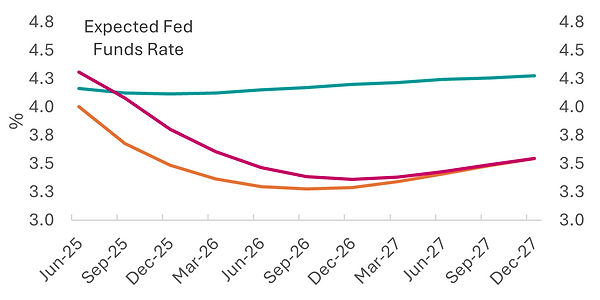
The May update shows a modest but important shift in market expectations for U.S. monetary policy. As the chart illustrates, the expected path of the Fed funds rate has moved slightly upward compared to April, now pricing a terminal rate around 3.6%—still above the Fed’s long-run projection of 3.0%, but lower than the earlyyear peak. This adjustment reflects a fragile balance: while recession fears continue to anchor expectations for rate cuts, inflation concerns driven by tariff policy, wage pressures, and tight labor markets are gradually pulling projections higher.
Source: FRED
Euro Area
In the Euro Area, the outlook remains mixed. Inflation is easing in many parts of the bloc but remains stubbornly high in the services sector, with recent readings rising from 3.5% to 4.0%. Germany’s economy showed modest growth in Q1 2025, buoyed by a temporary export surge ahead of anticipated tariff enforcement. However, the sustainability of that growth remains doubtful. The European Central Bank is now faced with the challenge of simultaneously encouraging recovery and curbing inflation. In the UK, inflation unexpectedly spiked to 3.5% in April, driven by surging household bills, wage hikes, and higher business taxes. These surprises raise questions about the credibility of the Bank of England and the persistence of inflation expectations.
The financial picture is also shifting. As shown in the chart above, the spread between U.S. and Euro Area 10-year bond yields has narrowed sharply, while the euro has strengthened against the dollar, an indication that investors are re-evaluating the dollar’s role as a safe haven amid rising fiscal and policy risks in the U.S. This realignment may provide short-term support for European assets, but it also underscores the fragile confidence undergirding global capital flows.

Source: Eurostat, FRED
Russia
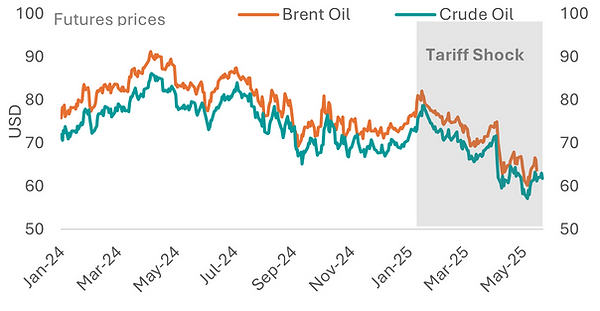
Russia finds itself in an increasingly precarious position. Following strong wartime growth, the Russian economy is now slowing sharply. Credit activity has stalled under the weight of high interest rates, while falling oil prices, which in turn has had a direct impact on revenues from oil exports. This trend was already evident in April, when oil-related revenues fell to their lowest level since 2023. Inflation, however, remains persistently high, hitting 10.2% in April, despite a tight labor market and record-low unemployment. The Bank of Russia has held interest rates steady at 21%, signaling a difficult path ahead in its effort to tame excess demand in the face of mounting sanctions and continued war-related spending.
Source: investing.com
China
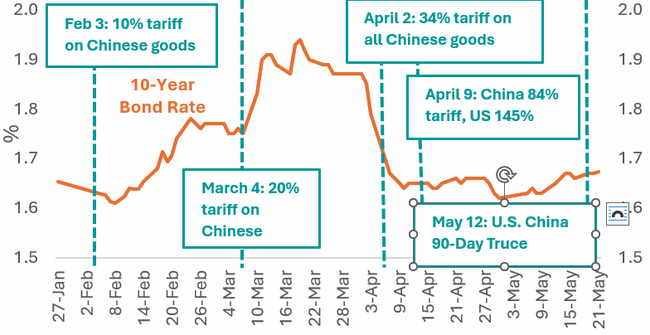
China stands out as one of the more resilient economies, at least in the short term. Growth for Q1 2025 reached 5.4%, surpassing expectations thanks to strong industrial output and public investment. Yet structural weaknesses, particularly in the property sector, continue to weigh on household confidence and private consumption. In response, Chinese authorities have launched a new “special action plan” to support domestic spending. However, trade tensions with the United States have returned to the fore. While the recent 90-day tariff truce offers a temporary reprieve, financial markets remain wary. Bond yields are rising, and the yuan is facing depreciation pressures, as the country grapples with the real risk of another external shock to its vital export sector.
Source: National Bureau of Statistics of China