


Global Economy Risk Assessment
Global Growth Is Breaking Through the Headwinds
By The Better Policy Project & AI Powered Learning| September, 2026

Stronger Growth Could Signal a Fundamental Shift
The global economy is proving far more resilient than the shocks hitting it would suggest. Growth has been revised up through 2026, and several major economies now sit above the expectations formed before the Iran war.
Those pre-war forecasts did not include the oil shock and captured only part of the tariff drag. If growth is rising while both subtract from activity, underlying demand must be stronger than the headline numbers show. The evidence points to one source: the AI investment boom.
Figure 1. 2026 growth nowcasts sit above the IMF's latest forecasts in every major economy, and above pre-war expectations in most.

Source: IMF WEO, Author's calculations
The AI Investment Boom Is Becoming Macroeconomically Significant
Quarterly capital spending by Amazon, Google, Microsoft and Meta has risen from about $34 billion in early 2023 to $171 billion in Q2 2026, roughly fivefold. These four firms now invest more in a single quarter than they did in a full year at the start of the cycle.
Figure 2. Quarterly capital expenditure by the four largest US hyperscalers has risen roughly fivefold since early 2023.

Source: Company filings and financial reports
What matters for the economy is the timing: the demand for chips, power, construction and skilled labour arrives now, while the productivity gains come later.
Asia's Factories Feel the AI Build-Out
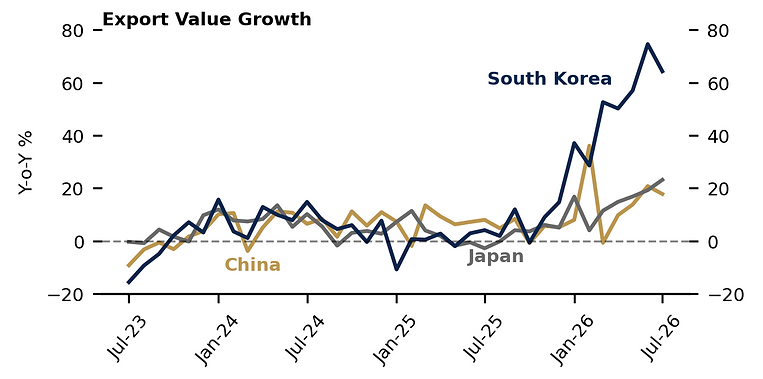
Export growth has accelerated sharply across South Korea, China and Japan, and the surge is concentrated in the chips, electronics and equipment tied to AI. Economies that had been slowing global growth can now add to it, If AI-related demand continues to strengthen their exports, manufacturing and investment.
Figure 3. Export values have accelerated sharply across major Asian suppliers.
Source: GACC, Japan Ministry of Finance, Bank of Korea.
Governments Are Adding Demand at the Same Time
OECD gross sovereign borrowing is projected at 24% of GDP in 2026 and roughly 50% above 2022 level. Global military spending reached around $2.9 trillion in 2025. Defence draws on many of the same inputs as AI, from semiconductors to electricity and skilled labour. When public borrowing and private capex rise together, demand can outrun supply, keeping the rate needed to balance the economy higher.
Figure 4. OECD sovereign borrowing is rising at the same time private investment is growing.

Source: OECD Global Debt Report 2026.
Equities Shrugged Off War, Oil and Tariffs
The S&P 500 has more than recovered its war losses, despite a much higher expected path for interest rates. That rally has added around $13 trillion to US household equity wealth since Q1 2026: about 40% of annual U.S. GDP in only a few months. Greater wealth can reduce desired saving, allowing households to consume a larger share of current income and thereby support aggregate demand.
Figure 5. The S&P 500 has more than made up its losses since the war began.

Source: OECD Global Debt Report 2026.
Bond Markets Are Sending the Same Signal
Long-term government bond yields are rising across major economies. There are four possible explanations: higher inflation expectations, stronger actual or potential growth, heavier government borrowing, or a higher term premium. However, for the policy outlook, the exact decomposition matters less than the common implication: each explanation points toward a higher interest rate required to balance the economy.
Figure 6. Ten-year sovereign yields have moved sharply higher across economies.

Source: FRED, ECB, Japan Ministry of Finance, Bank of England, Bank of Korea.
The Policy Risk
Treat today's inflation as just an oil story, and rates could end up too low for an AI-driven economy. If AI investment is lifting both demand and the neutral rate, today's policy stance is looser than it appears.
Oil Remains a Separate Tail Risk
Middle Eastern supply has become more fragile. Hormuz is still running well below pre-war flows, Houthi control around the Bab al-Mandeb threatens the main alternative route for Saudi exports, and Saudi Arabia's East–West bypass pipeline was damaged in September. The buffers that absorbed the first shock (non-Gulf supply, weaker demand, inventories and IEA releases) are now much thinner, so a renewed disruption would likely hit prices harder than the first.
Four Paths for the Outlook
Two questions decide the path: how the AI-and-fiscal demand story plays out, and whether the oil buffers hold.
Market Reference
AI raises the neutral rate; capacity keeps pace.
Case A
Policy falls behind; Demand outruns capacity; rates stay higher for longer.
Case B
Productivity takes over; AI gains arrive faster; rates normalise sooner.
Case X
The oil buffer fails; A renewed energy shock hits depleted buffers.
Growth, inflation and policy-rate projections for each path are in the full report.
The Full Picture Is in the Report
-
Deep dives on the United States, the Euro Area and China
-
Growth, inflation and policy-rate projections for four scenarios
-
Oil market analysis and price scenarios
Available to subscribers on www.ai-powered-learning.org.