


Global Economy Risk Assessment
Absorbing the Hormuz Shock: How Long Can Buffers Last?
By The Better Policy Project | August, 2026
A Mounting Storm for the Global Economy
The global economy has so far absorbed an exceptionally large disruption to Gulf energy supply without the corresponding collapse in activity that might normally be expected. Before the disruption, around 20 million barrels per day of petroleum passed through the Strait of Hormuz, while the conflict has generated an average supply loss of roughly 14 million barrels per day.
The relatively contained economic response reflects unusually strong buffers. The oil market entered the conflict with an estimated 2.5 million barrel-per-day supply surplus, while alternative export routes, strategic stock releases, commercial inventories and weaker demand have reduced the effective shortage reaching the global market.
But these buffers are finite. If Gulf supply recovers soon, inventories can begin to rebuild and the disruption remains manageable. If it persists, inventories will continue to decline, alternative routes will become increasingly constrained and the physical shortage will become harder to absorb. The central question is therefore increasingly how long the disruption lasts relative to the buffers available to absorb it.
Oil Prices Have Fallen, But the Risk Has Not Disappeared
Oil prices have retreated despite the scale of the physical disruption. Strategic stock releases, inventory drawdowns, alternative pipelines and weaker Chinese purchases have all limited the shortage reaching the international market. This explains why prices have remained considerably more contained than the loss of Gulf supply alone would imply.
However, this should not be confused with normalization. Continued inventory drawdowns progressively weaken the market’s ability to absorb the shock, while alternative shipping routes are longer, more expensive and capacity-constrained. A prolonged disruption could therefore become more damaging even without a further deterioration in Gulf production.
Oil prices remain highly volatile as markets reassess whether Gulf supply will recover before existing buffers are depleted
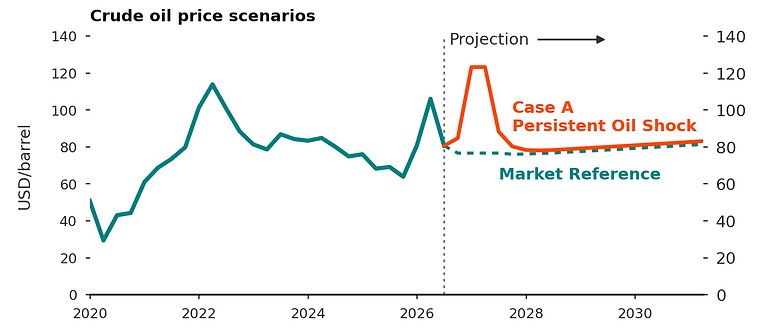
Source: IEA, BPP Projection
Rerouting has cushioned the Hormuz shock, but global energy trade remains concentrated through a small number of vulnerable maritime chokepoints.

Source: IEA
Against this backdrop, three global scenarios are considered, differing primarily in the duration of the Gulf disruption and the strength of the supply-side response.
The Market Reference Scenario assumes that regional tensions gradually ease, Gulf production and shipping conditions normalize, and depleted petroleum inventories begin to rebuild. The current disruption remains economically significant but temporary, allowing global disinflation to continue without a broader supply-chain contraction.
Case A: Persistent Gulf Disruption assumes that the disruption lasts long enough for inventories and other buffers to weaken materially. As these protections decline, a larger share of the physical supply loss reaches the global market, increasing inflation pressure and eventually constraining production and trade.
Case B: AI-Driven Productivity Upside assumes that the energy shock fades while stronger AI-related productivity raises potential output. Stronger supply capacity supports higher growth with less inflationary pressure, allowing inflation to return toward target more quickly.
Across all scenarios, the key uncertainty is no longer simply the size of the initial Hormuz shock. It is whether Gulf supply normalizes before the buffers that have contained its economic effects are materially depleted.
Japan: Inventories Have Kept the Shock at Bay
Japan provides a useful illustration of why the disruption has not yet translated into a broader decline in economic activity. Despite its heavy dependence on imported Gulf oil, Japanese activity has remained relatively resilient following the initial shock, suggesting that constrained Gulf supply has not yet become a binding restriction on production.
A key reason is that Japan has been able to draw on existing petroleum inventories to compensate for weaker imports. This has delayed the transmission of the oil shortage into domestic production. But the protection is temporary: if Gulf supply remains constrained and inventories continue to decline, the shock could eventually begin to weigh more visibly on economic activity.
Japan has relied on oil inventories to cushion the disruption, but a prolonged shock could progressively erode this buffer

Source: BPP Calculations
United States
The U.S. economy remains resilient, while inflation continues to move gradually lower. Headline CPI inflation eased to 3.4% year on year in July and core inflation to 2.5%, although sticky-price measures remain elevated. Hiring has also slowed without a comparable rise in unemployment, leaving the labor market in a relatively stable “low-hire, low-fire” equilibrium.
Financial markets continue to reflect two-sided risks. Following the July Fed decision, the 2-year Treasury yield declined while the 30-year yield increased modestly. Lower short-term yields suggest greater confidence that improving inflation could eventually allow policy normalization, while the long end continues to reflect uncertainty around persistent inflation, fiscal dynamics and the term premium.
The July Fed decision pushed short- and long-term Treasury yields in opposite directions, highlighting the divide between improving near-term inflation and persistent longer-term risks

Source: Bloomberg
Euro Area: Growth Improves, but the Energy Trade-Off Returns
Euro-area growth has improved, but the recovery remains fragile and increasingly reliant on fiscal support. Germany has benefited from higher infrastructure and defence spending, while France and Italy remain close to stagnation and Spain continues to outperform.
At the same time, the renewed energy shock is beginning to move through the inflation pipeline. Energy import prices and domestic energy producer prices have risen sharply, although broader pass-through into intermediate goods remains relatively limited so far.
This leaves the ECB facing a difficult trade-off. If the shock remains concentrated upstream, policymakers may be able to limit their response. But if higher energy costs spread more broadly through the production chain, the ECB could be forced to tighten despite weak underlying demand.
The energy shock is increasingly visible upstream, while broader pass-through into the euro-area economy remains limited so far.

Source: Eurostat
China: External Resilience, Domestic Weakness
China’s expansion has become increasingly uneven. Real GDP growth slowed from 5.0% year on year in Q1 to 4.3% in Q2, while industrial production has remained comparatively resilient. Domestic demand remains much weaker, with retail sales slowing and real estate investment continuing to contract sharply.
Inflation pressures also remain highly uneven. Consumer inflation is still subdued, reflecting weak household demand, while producer prices have moved sharply higher as energy and other input costs rise. The Middle East shock is therefore being transmitted much more strongly through firms’ cost structures than through consumer prices.
Exports remain an important buffer, supported by high-tech manufacturing and continued trade reorientation toward ASEAN, Europe and other non-U.S. markets. This is supporting growth in the near term, but also leaves China increasingly dependent on external demand while the domestic economy remains weak.
Producer prices show much stronger cost pressure than consumer inflation as the energy shock works through Chinese industry

Source: NBS